
Reading City Directory Collections
Reading's historical city directory evidence is spread across a cataloged combined-town book, the Massachusetts State Library holdings list, and local library collections that supply companion records. The state list is the most dependable map of the located Reading year runs. It is not a claim of uninterrupted publication or survival. Search each dated volume as its own snapshot, and keep the repository and year in a research note.
| Collection | Years | Where Held | Access |
|---|---|---|---|
| Stoneham, Wakefield and Reading directory, J.L. Parker | 1869 | Historic New England catalog | Catalog record; scan status must be confirmed |
| Massachusetts State Library city and town directories | 1869, 1874, 1884, 1886-87, 1888-89, 1892-93, 1896-97, 1898-99, 1900-01, 1902-03, 1905, 1907, 1909, 1911-12, 1913-14, 1915-16, 1917-18, 1919-20, 1921-22, 1925, 1931-32, 1934, 1936, 1938, 1941 | Massachusetts State Library | Consult the official holdings list and library access routes |
| Reading Public Library local history | Yearbooks 1892-2021; annual reports 1871-2007 | Local History Room and digital archive | Room by request; archive access varies by item |
| Reading Chronicle and related newspapers | Chronicle authority record: 1881-1980 | Reading digital archive and library collections | Search the archive, then verify the page image |
The gaps matter. No official source identified a continuous Reading Polk run, a continuous criss-cross run, or a separate local telephone-book sequence. A missing name between two surviving city directories does not prove that a family moved, that a house was empty, or that an address did not exist.
Reading's 1869 Directory
The first located Reading-specific directory is a combined Stoneham, Wakefield and Reading volume. Historic New England's catalog record identifies its full title as a general directory of citizens, business directory, and town records for the year beginning June 1, 1869. It names J.L. Parker of Woburn as publisher, gives a length of 214 pages, and lists the Heritage catalog call number as F74.S88 S86 1869.
That combined geography needs care. South Reading became Wakefield in 1868, so a searcher should check the town section before treating a surname hit as a Reading household. The inspected catalog offered item-level metadata, not a stable line-by-line scan. It is therefore sound to use the title, date, publisher, places covered, and call number, but not to invent a sample person's address or occupation from the catalog description.
Reading Directory Years at the State Library
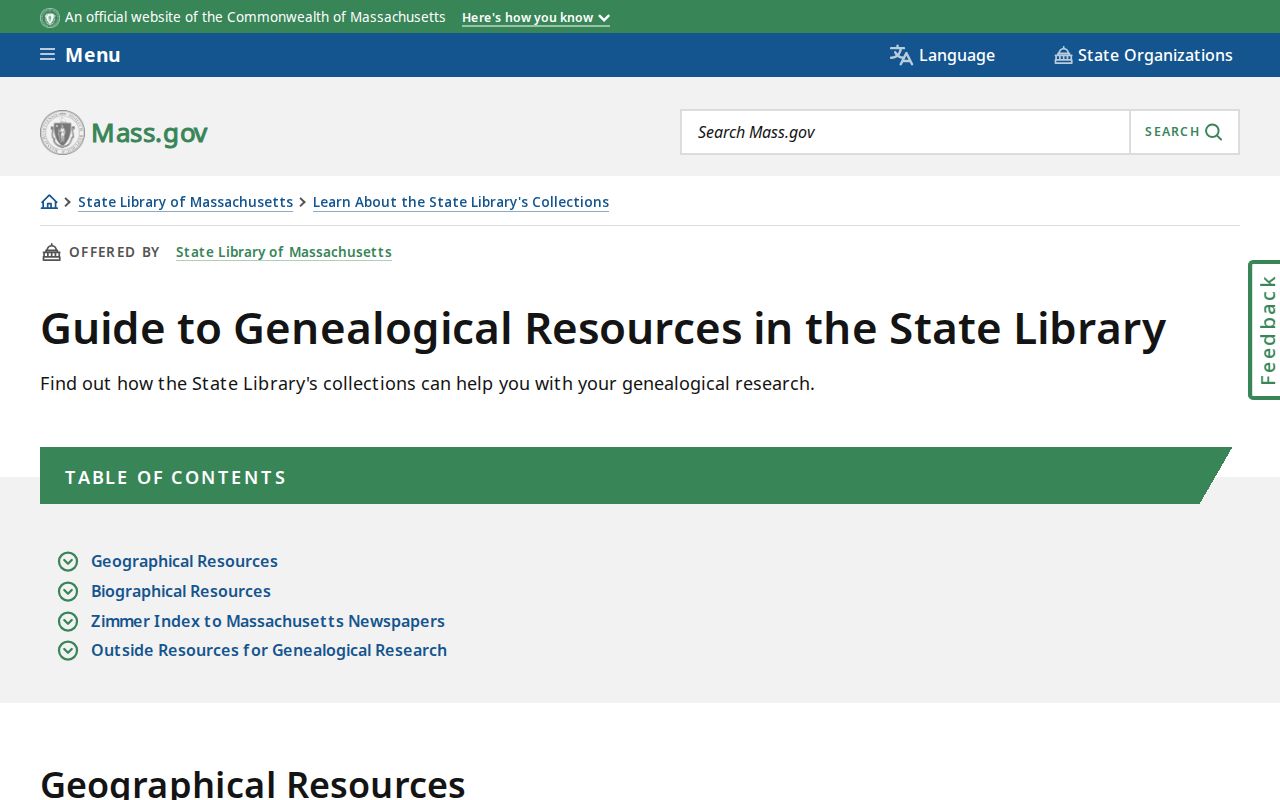
The State Library's city and town directory list preserves the exact Reading years in the coverage table. Those staggered volumes are especially useful between census decades. The State Library's broader genealogy guide explains that Massachusetts directories are generally surname-organized and can include house guides, business advertisements, town information, and voting material.
The State Library genealogy guide is the source shown below. Its holdings guidance helps distinguish a listed collection from a fully digitized, searchable run.
Use the holding list to request or locate a year, then inspect the volume's own introduction and index. A house guide may be present in one directory and absent in another, so the table of contents and abbreviation key deserve a look before a name search begins.
Reading City Directory Entries
A directory entry is a compact lead, not a complete biography. The precise fields vary by volume. The 1869 catalog confirms the book's general-directory and business-directory structure, but no official page image was located that permits a transcription of an actual Reading line. The inventory below identifies fields worth recording only when they are visible in the particular volume being consulted.
| Name | Record the surname, given name, initials, and spelling exactly as printed. |
|---|---|
| Street or address | Copy the number, street spelling, town section, and any abbreviation without modernizing it. |
| Household notation | Note a spouse, widow, householder, or other relationship marker only if the volume prints one. |
| Business or occupation | Preserve the wording as printed, including a shop or other business name when present. |
| Marks and cross-references | Check the volume's key before interpreting an abbreviation, ownership mark, or reference. |
- Criss-cross directory
- An address-ordered directory that reverses the usual surname-first route and can identify listed occupants at a street address. No continuous Reading run was verified.
- Householder index
- An index that groups entries by household or address when a particular volume includes one. It is not guaranteed in every city directory.
- Abbreviation key
- The explanatory list, often near the front of a volume, that tells the reader how its short forms and symbols work. Photograph or transcribe it with the entry.
Reading Local History Research
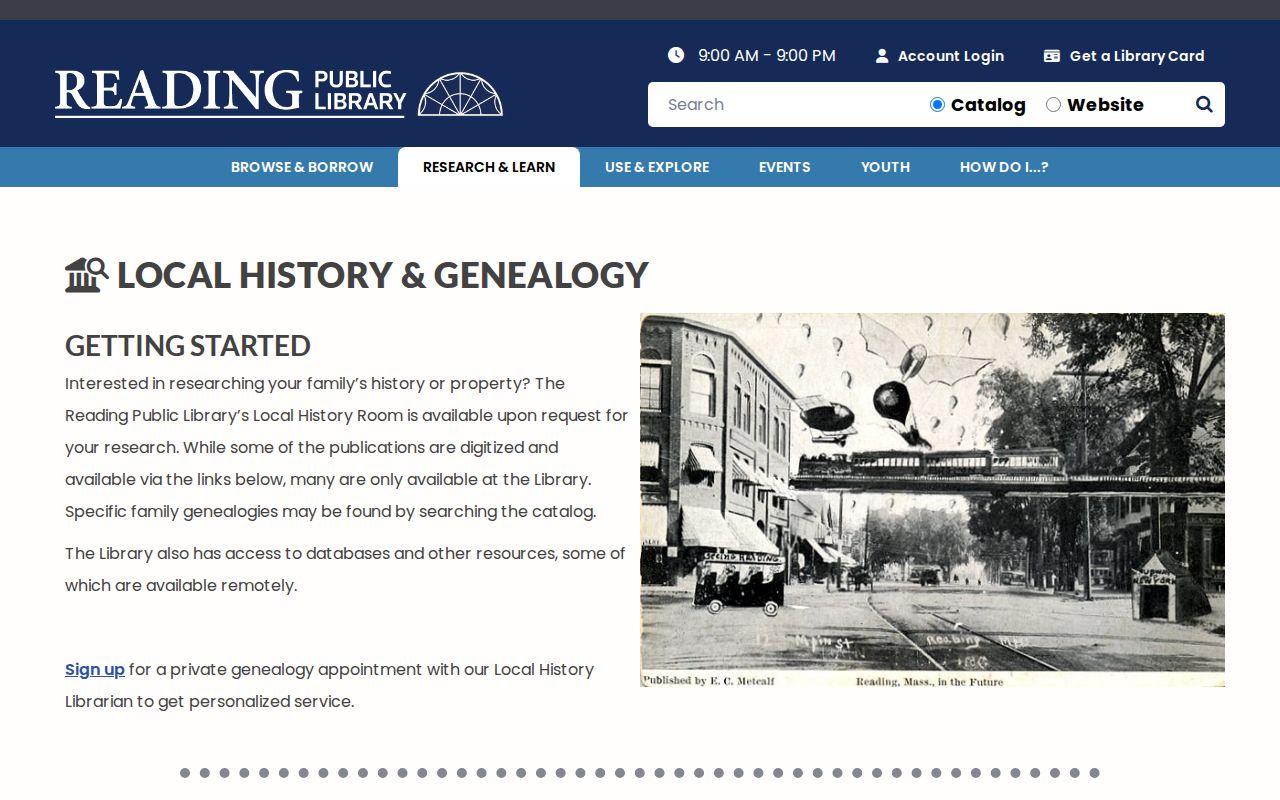
Reading Public Library's Local History and Genealogy service offers a practical next stop when city directory evidence needs corroboration. The Local History Room is available by request, and the Local History Librarian offers private genealogy appointments. Ancestry Library Edition and American Ancestors are available in the library; MyHeritage Library Edition is available remotely to Reading residents; FamilySearch is available in the library with a free account.
The same service points researchers to newspapers on microfilm or in digital form, obituaries, yearbooks, town reports, historic maps, Reading vital records to 1850, and a “Research Your Home” guide. These are separate routes. A surname may work best in a directory, while an address or a reported event may be easier to locate in a newspaper or town report.
The library's service page describes the local-history resources and access choices pictured here.
Bring a focused request: a name variant, an approximate year, a street, and the record type sought. That gives library staff a workable starting point without turning an unverified directory gap into a conclusion.
Reading Chronicle Directory Clues
A name that appears in a Reading city directory can be checked against the Reading digital newspaper archive for notices, business references, local events, and obituaries. The Library of Congress authority record identifies the Reading Chronicle as a Reading weekly with 1881-1980 coverage and records its merger history. Archive coverage and scan availability can vary by title and year.
Search OCR with the directory spelling and a second spelling, then read the page image before relying on the hit. Initials, damaged type, and street abbreviations often confuse OCR. An obituary or notice can establish a date and a local connection, but it should be paired with the directory year and, when appropriate, a deed or census record.
Reading Directory Companions
When a directory does not supply enough detail, Reading's local collections can add a dated setting around the name. The library describes Reading High School yearbooks from 1892-2021, while the digital archive presents Pioneer Yearbooks with a broader displayed date range of 1854-2021. Verify the specific issue before relying on a school year. The archive also displays annual reports from 1871-2007, which can identify civic bodies, town departments, projects, and other context without serving as a household roll.
These sources answer different questions. A yearbook can connect a name to a class, club, or portrait. An annual report can establish the name of an institution, official, or project in a given year. A newspaper can date a local event or notice. Put each result beside the directory entry instead of merging them into a single untested story about a person or address.
Trace Reading Directory Households
Directories are strongest when used as a sequence. Federal census schedules are public through 1950 under the 72-year release rule, while a directory gives a nearer dated snapshot when one survives. The goal is to trace a household carefully through the gaps, not to treat a single entry as proof of a continuous stay.
- Choose the earliest located directory year that brackets the question and record every spelling, initial, spouse notation, and address form.
- Check the next surviving Reading directory year, noting both unchanged details and a move, business change, or disappearance.
- Where a house guide is actually present, search the street and address; do not assume the volume has a criss-cross section.
- Pair the directory evidence with the nearest federal census and compare household members, street name, and town designation.
- Use a newspaper notice, deed, or probate record to test whether a disappearance reflects a move, death, ownership change, or merely a gap in the collection.
For an address-centered trail after the directory years, the previous residents search follows deeds, parcel history, and census evidence backward. A directory absence alone does not establish vacancy or departure.
Reading House History Records
Reading's historic-property material supplies an address-first companion to city directories. The Historical Commission inventory covers about 350 properties, roughly four percent of the town's structures, with dates from 1694 through 1953. Its street-organized records can identify a property name, style, date, inventory number, current use, and National Register status. These features help connect an old street reference to a named place, but they do not identify every person who lived there.
- 1694: Parker Tavern at 103 Washington Street was built, according to the Reading Antiquarian Society.
- 1869: The combined Stoneham, Wakefield and Reading directory provides the first located Reading-specific directory sample.
- 1881: The Library of Congress chronology begins for the Reading Chronicle.
- 1941: This is the latest Reading year listed in the State Library holding list, not a verified final local printing date.
- 1950: The latest public federal census supplies a household snapshot under the 72-year release rule.
Parker Tavern offers a concrete example of the method: start with the 103 Washington Street historic property, then compare the historical inventory, deed description, directory entries, and local newspaper references. The town's FY2010 tax-map and lot renumbering can break a literal parcel match, so preserve old identifiers and use legal descriptions, plans, and adjacent properties to bridge them.