
Finding Reading Residents Carefully
Reading has no single official list of every person at every address. The useful route depends on whether the question concerns an assessed owner, a voter checking personal registration, a party to a recorded deed, or a past household. Start with the strongest available anchor, then compare it with a record held by a different custodian. That simple check prevents a same-name result or an old address from being treated as proof.
The town assessment roll, Middlesex South land records, and the library’s local-history collections each answer a different part of the question. The records are also dated. An assessment entry reflects a property record, while a directory, notice, or court item may describe an earlier moment.
- For an address, find the Reading parcel and its assessed-owner field.
- Use the parcel or legal description to inspect the recorded land trail.
- For a personal registration question, use the individual Massachusetts voter tool.
- For an older household, compare a directory year, census release, newspaper, and deed.
- When a known town record is not posted, send a precise written request to its custodian.
Reading Residents Records Desks
Reading is a Massachusetts town, so custody is divided. The Town Clerk keeps municipal vital, election, license, and municipal records. Assessment maintains the property roll. Middlesex South in Cambridge keeps recorded land, while Reading probate matters go to the North division in Lowell and district matters to Woburn. Choosing the right desk matters more than choosing the nearest one.
Reading Parcel Search Routes
The Reading assessor’s Patriot Properties screen offers three practical routes: Street Name, Owner Name, and Parcel ID. It reports FY2026 assessment data, with the town explaining that the assessment context reflects ownership and assessment changes as of January 1, 2025. An owner field is valuable for a property question, but it does not establish every person who lives there.
| Assessor field | Use | Reading note |
|---|---|---|
| Street Name | Browse locations on a street | Use the first letters and GO when needed. |
| Owner Name | Locate an assessed-owner record | A name may be an owner, not an occupant. |
| Parcel ID | Join assessment, map, and deed work | Useful when address wording varies. |
For a visual reference, the Reading assessor search shows those three entry points. 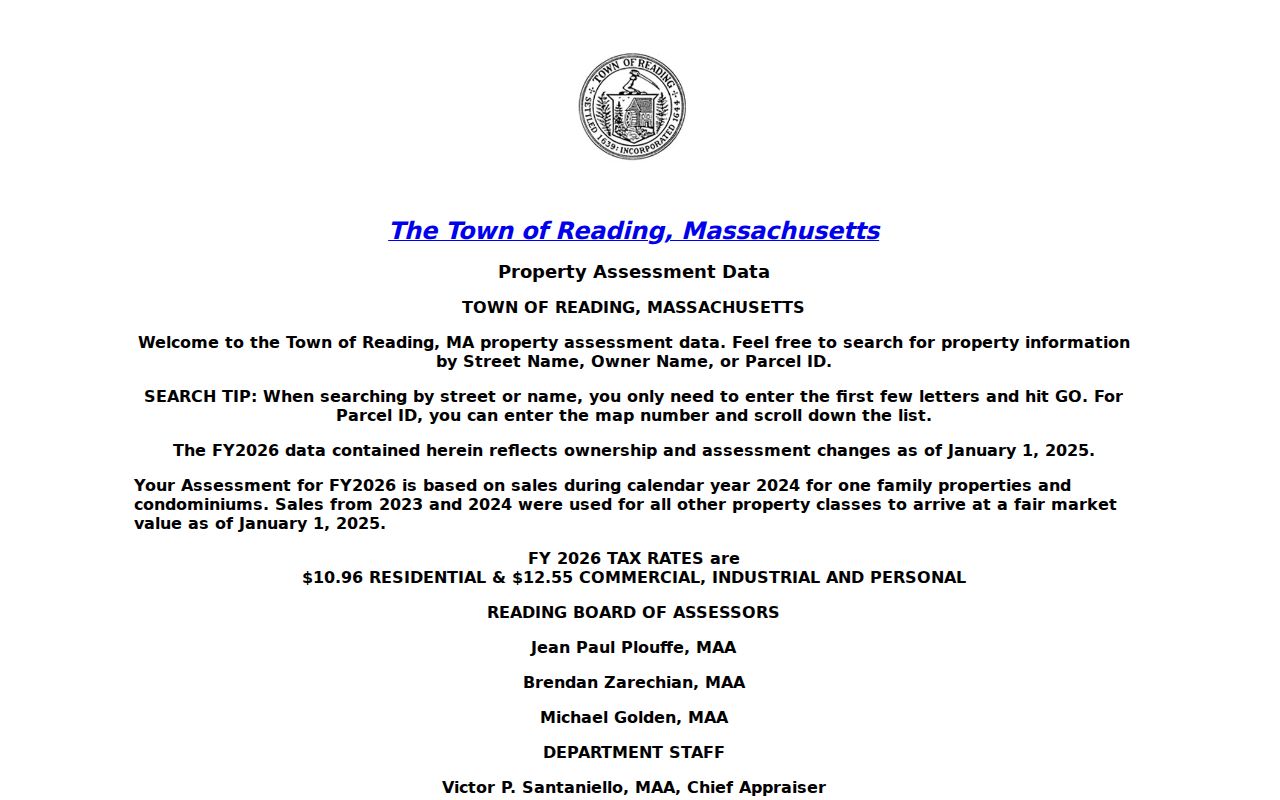 Carry a resulting parcel ID into the map or Registry instead of treating a single screen as the whole residents directory.
Reading Street Listing Evidence
The town’s 2025 Street Listing is a public, browseable PDF route when a dynamic search is awkward. Its roughly 216 pages show Location, Current Total Value, Owner1, Owner2, Parcel ID, NBC, LUC, and Area. It is best used to find a location and parcel on a named street, then to compare the result with assessment detail and map geometry.
Each label has limits. Location is a situs, or property location. A mailing address found in an abutters file can be elsewhere. Owner1 and Owner2 are assessed-owner fields. Neither is a full household roster. The Reading street directory follows that address chain in more detail.
- Parcel
- A mapped property unit with an identifying number.
- Index
- A finding tool that points to a record, not the complete record itself.
- Roll
- A list maintained for a defined public purpose, such as assessment or elections.
- Criss-cross directory
- An address-first directory, if a volume actually includes that arrangement.
Reading Deed Party Trails
Middlesex South’s MassLandRecords system connects Reading properties to deeds, mortgages, releases, liens, plans, and other recorded instruments. Recorded Land, Registered Land, and Plans are separate search areas. A careful search can use a party name, town, document type, and recording date, then narrow broad results. Registry instructions warn that a broad request can reach the first 1,000 rows.
A deed gives a dated party relationship, not a current resident list. Read the grantor, grantee, legal description, book and page or document number, and the recording date. Then use the seller as an earlier grantee when tracing ownership backward. Official images could be viewed, printed, and downloaded free when inspected; a certified copy remains a different product.
The Middlesex South deed interface supplies the party, property, and date paths. If a known municipal file is absent, the Town’s request channel is the fallback, not a guessed record.
Reading’s public-records page shows the municipal request route. 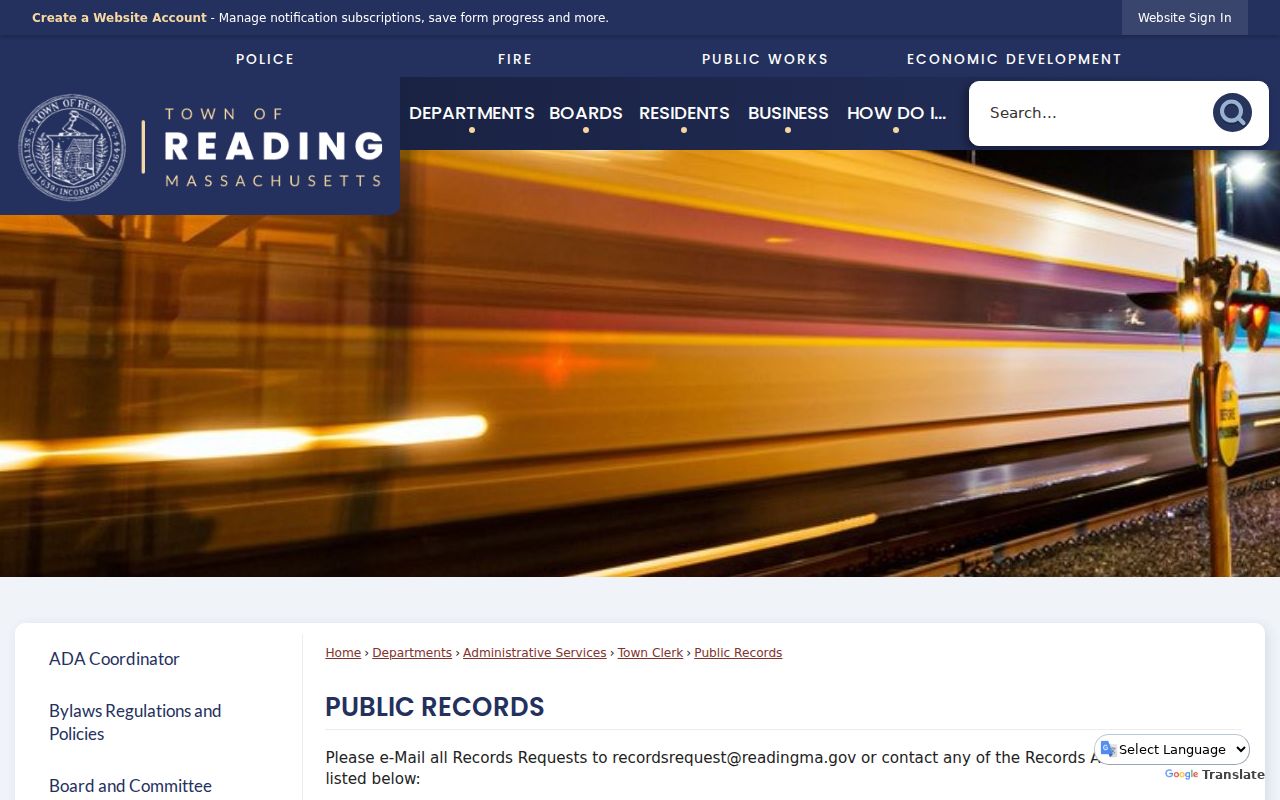 Name the existing record, address or name, and date range so the custodian can locate the right file.
Reading Voter Status Limits
Massachusetts offers an individual voter-status form, not a public Reading-wide people list. It asks for first name, last name, birth month, day, year, and the five-digit ZIP of the person’s residential address, followed by an acknowledgment. A match can help a voter check personal status. It cannot be used to export everyone on a street.
| Individual status tool | Name, date of birth, ZIP, and acknowledgment are required. |
|---|---|
| Local public-file route | Reading Elections/Town Clerk holds local records and follows state access rules. |
| Withheld material | Confidential-voter information, phone, email, and other protected fields are not ordinary public output. |
The voter-status screen shows its required inputs.  A result or non-match must never be treated as proof that a person is, or is not, present in Reading.
Reading Court Name Checks
MassCourts is useful only after the court is routed correctly. Woburn District Court handles Reading district matters. Middlesex Probate and Family Court North in Lowell handles Reading probate and family matters. The portal has department, division, location, name, case type, case number, and ticket paths. A same-name result can contain several parties in one case, so court location and case type are essential checks.
Public docket information varies by department and case type. Juvenile, sealed, impounded, confidential, and similar records are not ordinary web material. Use the clerk or public terminal when an available record needs a permitted review or copy.
MassCourts instructions explain the required formatting and search choices. 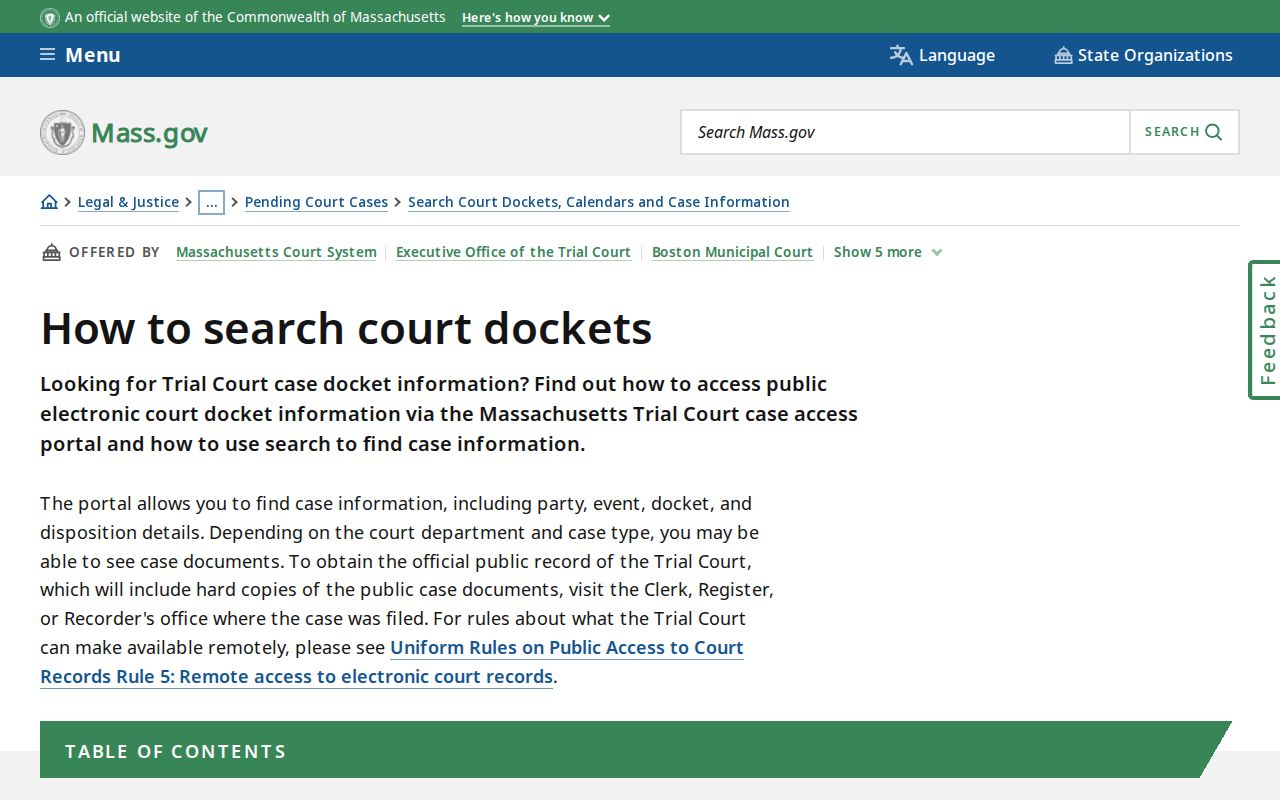 Court participation is a dated record fact, not a standalone identity or residence confirmation.
Current Reading Resident Sources
Current sources are best viewed as separate lists with different purposes. An assessment row identifies an assessed owner and parcel. A voter status result is limited to the person using the official tool. A Registry index names parties to filings. The staff directory identifies public staff, and the Chamber lists participating businesses. None replaces the others.
| Reading source | What it identifies | Keeper | Access route |
|---|---|---|---|
| Assessment and Street Listing | Assessed owner, location, parcel | Reading Assessment | Free portal and public PDF |
| Recorded-land index | Parties, document type, dates | Middlesex South | MassLandRecords |
| Voter records | Individual status or permitted local file fields | Town Clerk/Elections | Individual form or local request |
| Library collections | Historical names and affiliations | Reading Public Library | Room, archive, and appointments |
For a name that needs corroboration across these distinct records, use the focused Reading resident lookup workflow rather than assuming that one result settles the question.
Reading Vital Record Paths
The Reading Town Clerk is the local registrar for qualifying births, marriages, and deaths and issues local certified copies for $10 each. A request uses the event-specific names, date, and place required by the town. Statewide ordering is also available from the Registry of Vital Records and Statistics through online, telephone, mail, and in-person channels. Those access routes are useful when the local custodian is not the proper one.
Massachusetts General Laws chapter 46, section 2A controls access to recent vital records. The working periods are 90 years for births and marriages and 50 years for deaths, subject to the statute’s exceptions. An old index, a historical catalog, and a certified copy are not interchangeable.
The Commonwealth’s vital-record order page shows the state options. A professional-license search can confirm a public license status, but it is not a current residents directory.
Massachusetts license lookup uses individual and business search routes. 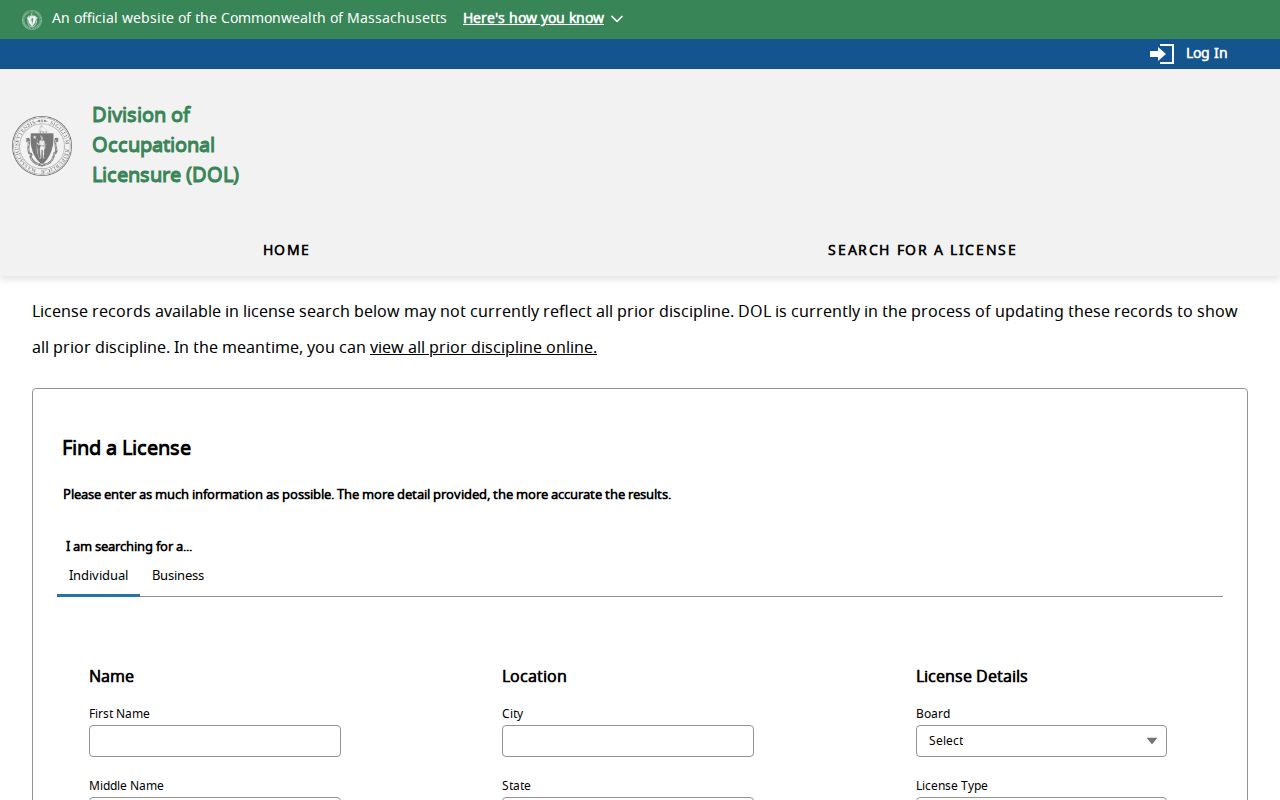 Treat a displayed license as a public status record, not a residential address record.
Reading Historical Directory Shelves
Reading’s library and statewide collections provide the historical layer. The first located directory item is the 1869 combined Stoneham, Wakefield and Reading volume published by J. L. Parker. The Massachusetts State Library lists later Reading runs through 1941, with gaps. A gap in a directory sequence does not prove that a household left an address.
Reading Public Library offers a Local History Room by request, private genealogy appointments, newspapers, obituaries, yearbooks, maps, and a Research Your Home guide. Its digital archive brings together local news, annual reports, and yearbooks. The full historical shelf belongs on the Reading directory book page.
The library also provides Ancestry Library Edition and American Ancestors in the library, MyHeritage Library Edition remotely for Reading residents, and FamilySearch in the library with a free account. These are separate access channels. Use a surname, street spelling, year, and town heading when moving between them, especially because the 1869 volume includes Stoneham and Wakefield as well as Reading.
Reading Parcel Number Change
Reading renumbered all tax maps and lots in FY2010 to support new financial software and simplify numbering. That local change is a real trap when an old tax list, directory note, or property file carries a map and lot reference that does not match a current screen. Preserve the old reference before replacing it with a modern parcel ID.
Use parcel shape, legal description, plan, adjacent owners, and the town’s older map resources to bridge the two systems. Do not assume a historic street number or parcel identifier stayed unchanged. That care is especially important for an older house history or estate trail.
Reading Library Name Trails
The library’s digital archive is a practical local media stack. Its collection descriptions include Reading Chronicle material, Daily Times Chronicle material, annual reports, and yearbooks. A historical name can move from a directory to a newspaper notice, school yearbook, or town report, then back to a property or probate record. Check OCR against the page image because initials, surnames, and street abbreviations can be misread.
Former classmates and family historians can use the library’s yearbooks and local-history support to document an earlier connection. Those sources show a time-specific affiliation, not a present address. The library is also the better access channel when no continuous reverse directory or telephone run has been verified.
Reading Money Claim Checks
The Massachusetts Treasurer’s unclaimed-property search can be a lead for an owner or heir, but a match is not proof of current residence or entitlement. The claimant must meet the official verification process. It is also a useful scam check: use the official state route before paying a private sender who says a name appears in a claim.
The Treasurer’s search instructions show the official route. 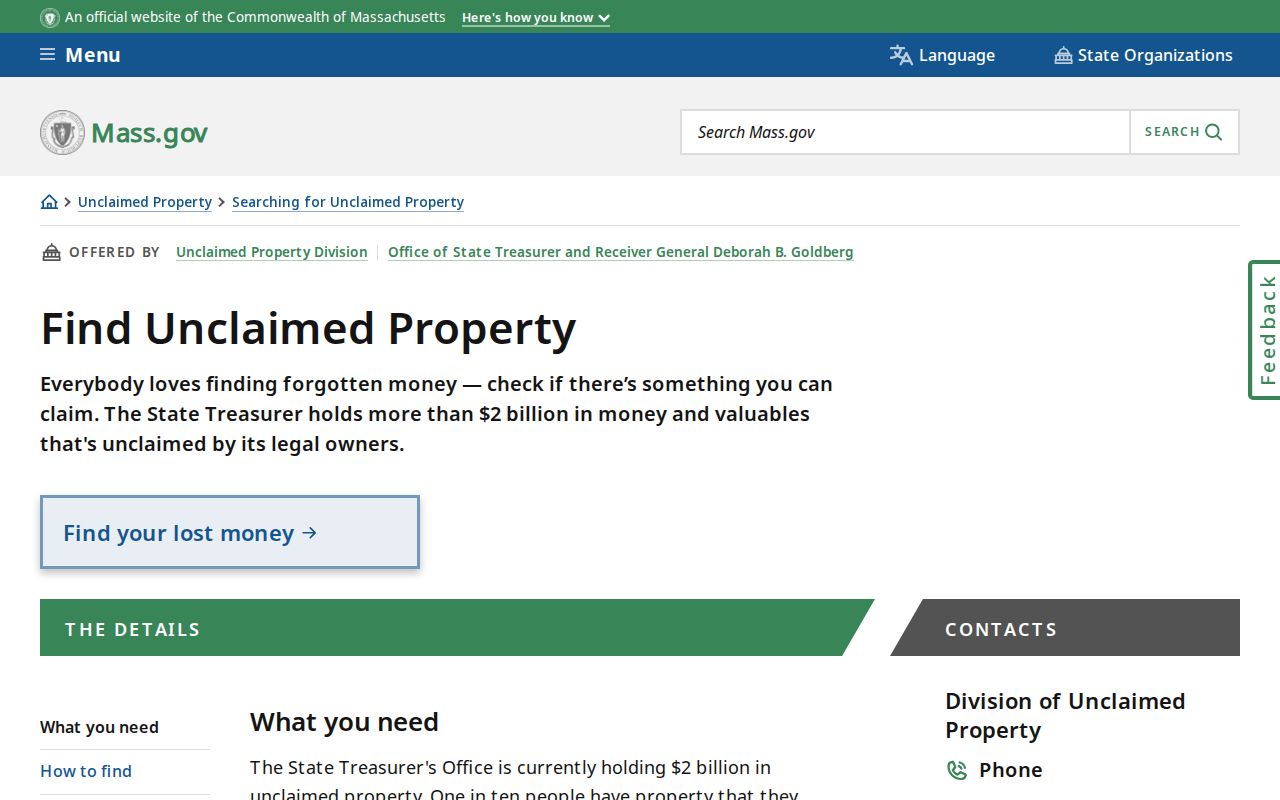 Keep the claim trail separate from the property and court records that establish a person’s documented connection.
Reading Deed Copy Safety
Middlesex South published a deed-copy solicitation warning in February 2025. A mailed offer can ask for money for a copy that the official Registry makes available to search, view, print, and download without charge at the time of inspection. Check a request against the Registry’s own website or its Cambridge phone number before paying for a supposed official copy.
There is still a difference between a viewable image and a certified copy. The Registry states that certified copies cost $1 per page, while a registered-land certificate costs $5. A document number, book and page, and recording date make a verification request much more reliable. The Registry also offers a Consumer Notification Service for alerts on up to three properties, a useful safeguard for a person monitoring a documented property interest.
Reading Records Request Fallback
When no online result exists, identify the custodian, the existing record, a name or address, date range, and desired format. Reading accepts written public-records requests in person, by mail, email, or fax, and identifies recordsrequest@readingma.gov as a municipal channel. Under Massachusetts Public Records Law, M.G.L. c. 66, section 10, a response is generally due within 10 business days, though a response can be a production plan or a denial that cites an exemption.
Requests work best for a defined permit card, abutters list, municipal report, or dated file. A custodian does not have to create a new list of people. Records can also be redacted or withheld under applicable law.
Keep a copy of the request, the response date, and any cited exemption. That record makes a later follow-up with the same custodian more precise and easier to route when needed.
Reading Privacy Boundaries
Massachusetts protects Address Confidentiality Program participants and confidential voters. Other limits apply to protected court files, sensitive vital material, motor-vehicle records, and certain professional-license details. A missing name can reflect a protected status, a date gap, a custodian difference, or a search mismatch. It does not justify trying to reconstruct a protected address.
Private compilation services may be stale or combine people with the same name. Official custodians provide the strongest route for checking a particular public record, and the source date should always travel with the result.